
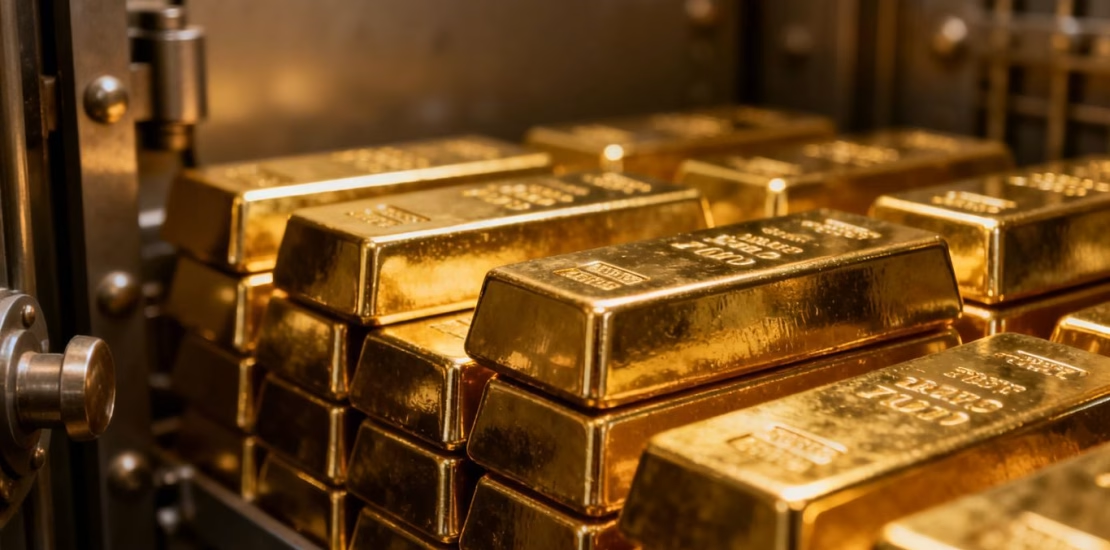
Are you wondering how central bank decisions and inflation might affect the price of gold in 2025? It's a relevant question, especially given recent market movements. This article reviews the current situation and offers insights into the upcoming challenges related to monetary policy and the price of gold in the face of inflation, with an update for 2025.
Key Takeaways
- Gold is seen as a safe haven asset, particularly during periods of economic uncertainty and in the face of inflation. Central banks play a significant role in its holdings, which influences its value.
- The price of gold depends on several factors, such as central bank decisions, demand from jewelers and industries, as well as global geopolitical and economic events.
- Forecasts for 2025 suggest that gold could continue to be an attractive asset, although various scenarios exist depending on macroeconomic developments, trade tensions and government fiscal policies.
Gold, a strategic asset in the face of monetary policies

In a world where central banks are constantly adjusting their monetary policies, gold is proving to be much more than just a precious metal. It is emerging as a true strategic pillar for your wealth. You may be wondering why, in this context, gold is generating such interest. It's a legitimate question, especially when you observe market movements and the decisions of financial institutions.
Gold as a safe haven and protection against inflation
History has shown us that when inflation rises, the value of our fiat currencies tends to fall. This is where gold comes in. It is traditionally seen as a safe haven, an asset that tends to retain its value, or even appreciate, when other financial assets are under pressure. Think of it as a kind of insurance for your money. When prices rise and your purchasing power decreases, gold can help preserve the value of your savings. It's a strategy many savvy investors adopt to protect themselves against monetary erosion.
- Preservation of purchasing power: Gold has historically demonstrated its ability to maintain its value in the face of inflation.
- Portfolio diversification: It offers an alternative to more volatile assets such as stocks.
- Confidence in times of uncertainty: In times of economic or geopolitical crisis, gold is often in demand.
The idea is simple: holding part of your wealth in a tangible form, independent of traditional financial systems, can bring you valuable peace of mind.
The role of central banks in gold holdings
It's not just individuals who are interested in gold. Central banks, the institutions that manage a country's reserves, are also major buyers. You might wonder why they do this. Well, they see gold as a way to strengthen the stability of their own reserves. By holding gold, they diversify their assets and reduce their dependence on foreign currencies, which can be subject to significant fluctuations. It's a strategy of prudence and resilience. In fact, by 2025, we're seeing a continued trend of central banks increasing their gold holdings, which demonstrates the importance they place on this asset.
| Year | Net gold purchases by central banks (tonnes) |
|---|---|
| 2023 | ~ 1000 |
| 2024 | ~800 (estimate) |
| 2025 | ~700 (forecast) |
This sustained demand from financial institutions reinforces gold's position as a strategic asset on the global stage.
Gold price fluctuations and influencing factors
So how does gold price Has it moved recently, and what's causing it to fluctuate? It's a question many are asking, especially when you look at the figures. In 2025, for example, we saw a rather spectacular rise of around 65%. That's the best annual performance since 1979, a year that was also marked by significant tensions, such as the Iranian Revolution and problems at the Three Mile Island nuclear power plant. That gives you an idea of the magnitude of events that can shake the markets.
The mechanisms for fixing the price of gold
Wondering how the price of gold is determined? Well, it's not that complicated when you look closely. Several exchanges around the world handle it, such as London, New York, and Zurich. London is somewhat the nerve center for precious metals. There are two types of prices: the "fixing," which is a reference price set twice a day by the LBMA (London Bullion Market Association), and the continuous price, which, as its name suggests, changes in real time, 24 hours a day.
- The Fixing It's a way of matching buyers and sellers at a specific moment. If supply and demand don't balance immediately, the price is adjusted until equilibrium is reached. It's a fairly clear measure of supply and demand at a given time.
- The Continuous Course Things are constantly changing here. You can track the price of an ounce of gold in dollars from Sunday evening to Friday evening. This is useful if you want to react quickly to changes.
The price of gold is therefore the result of a constant confrontation between supply and demand on global markets.
The impact of geopolitical and economic events on the price of gold
You've probably noticed that gold tends to rise when there's tension in the world, right? That's perfectly normal. When things get turbulent on the international stage, whether it's conflicts in the Middle East or trade disputes, investors look for a safe haven for their money. And gold is, in a way, the ultimate safe haven.
For example, concerns related to trade policies, such as the idea of imposing import tariffs, send shivers through the markets. This can lead to retaliatory measures, disrupt global trade, and consequently, put pressure on the dollar. And when the dollar weakens, gold, which is priced in dollars, becomes more attractive to foreign investors. It's a bit of a balancing act.
Central banks also play a significant role. They hold enormous quantities of gold, and their purchases or sales can influence the price. In 2025, we saw record demand from central banks, which are seeking to diversify their reserves. This supports the price of gold.
Basically, here's what makes the price fluctuate:
- Geopolitical tensions Wars, political instability, all of this pushes people towards gold.
- Monetary policy of central banks Interest rates, inflation, and decisions by the Fed or the ECB have a direct impact.
- The performance of the US dollar A weak dollar makes gold more expensive for those using other currencies.
- Demand from central banks and investors The more they buy, the higher the price goes.
- Major economic events Financial crises, recessions, anything that creates uncertainty.
Outlook and forecasts for the price of gold in 2025
Macroeconomic scenarios and their influence on gold
So, what does the future hold for gold in 2025? That's the question on everyone's mind, isn't it? We've seen a significant rise, almost 65% by 2025, which brings back memories of 1979. It was a tense period, with soaring inflation and a series of global events unfolding. Today, we're in a somewhat similar situation, with central banks juggling maintaining interest rates and the fear of a recession.
Several paths are possible for the price of gold. The most likely scenario, known as the base case, sees gold surpassing $5,000 an ounce. Why? Because even if inflation slows, it will likely remain slightly higher than central banks' targets. Interest rates could fall, but 10-year bond yields would remain stable. Rising debt levels and questions about government fiscal management are preventing long-term rates from falling significantly. The dollar, after a difficult 2025, should stabilize.
But be warned, there's also a more optimistic scenario: the bullish scenario. This envisions a more flexible central bank that cuts interest rates more aggressively. This could reignite inflation. Bond markets would adjust to lower rates, even if public debt increases. The dollar would continue to weaken due to deficits, and gold could well soar to $6,000 an ounce. That's significant!
Here is a brief summary of the forecasts:
- Basic scenario: Gold surpasses $5,000 an ounce. Inflation remains high, long-term interest rates are stable, and the dollar is stabilizing.
- Bullish scenario: Gold reaches $6,000 an ounce. The central bank is more accommodative, inflation picks up again, the dollar falls.
It's important to remember that these forecasts are based on models and surveys. Reality can always hold surprises, and financial markets are rarely 100% predictable.
Gold faces the challenges of trade fragmentation and fiscal hegemony
Beyond traditional monetary policies, other factors will play an important role for gold in 2025. These include how global trade will evolve and issues of public debt.
Trade fragmentation is a bit like global chaos. Tensions between countries, import tariffs—all of this creates uncertainty. When international trade is less fluid, it can weigh on the dollar. And as you know, when the dollar falls, gold tends to rise. It's a bit of a chain reaction. Stock markets, for their part, remain rather optimistic, which somewhat tempers the rise in gold prices, but geopolitical caution is definitely present.
Then there's fiscal hegemony. Essentially, this refers to a state's ability to spend and manage its debt. If states borrow too much, it can worry investors. They then look for safer assets, like gold. We're even seeing new players entering the market, such as some Chinese insurers who are starting to invest in gold. This creates new sources of demand, a more structural demand, which can support the price of the precious metal in the long term.
In summary, for 2025, gold appears well-positioned to continue attracting investors. Trade tensions and sovereign debt concerns are favorable conditions. Remember that gold has always been a safe haven in times of uncertainty, and 2025 should be no exception. It will be crucial to closely monitor how these various factors interact to understand gold price movements.
What does the future hold for the price of gold in 2025? Experts share their insights on upcoming trends. Staying informed is crucial for making the best decisions. To learn more about forecasts and how to invest, visit our website today!
So, what do we remember for 2025?
So, that covers everything for this 2025 update. As you've seen, gold is volatile. Between central bank decisions, global tensions, and even people's everyday habits, the price of an ounce can fluctuate wildly. It's not always easy to keep up with, we agree. But one thing is certain: if you're looking to save a little or protect yourself against unforeseen events, gold remains an option worth considering. Think about it, carefully analyze your situation, and make informed choices. See you soon for another analysis!
Frequently Asked Questions
Why is gold considered a good investment when inflation rises?
Imagine you have 10 euros and with that you can buy 10 candies. If prices rise and those same candies now cost 2 euros each, your 10 euros only buy you 5. Your money has lost value. Gold, on the other hand, tends to retain its value, or even increase, when currencies like the euro or the dollar lose purchasing power due to inflation. That's why it's considered a safe haven.
How do central banks influence the price of gold?
Central banks, like those of France and the United States, buy and sell gold to manage their countries' reserves. When they buy a lot of gold, it increases demand and can drive up the price. When they sell it, it can drive down the price. They therefore play a significant role in what is known as supply and demand, which determine the price.
Could the price of gold change significantly in 2025?
Yes, it's entirely possible! The price of gold can be influenced by many things: what central banks do, whether there are wars or tensions in the world, whether the economy is doing well or poorly, and even by political decisions. Experts believe that the price of gold could continue to fluctuate, either rising or falling, depending on all these events. So, it's important to stay informed!
