
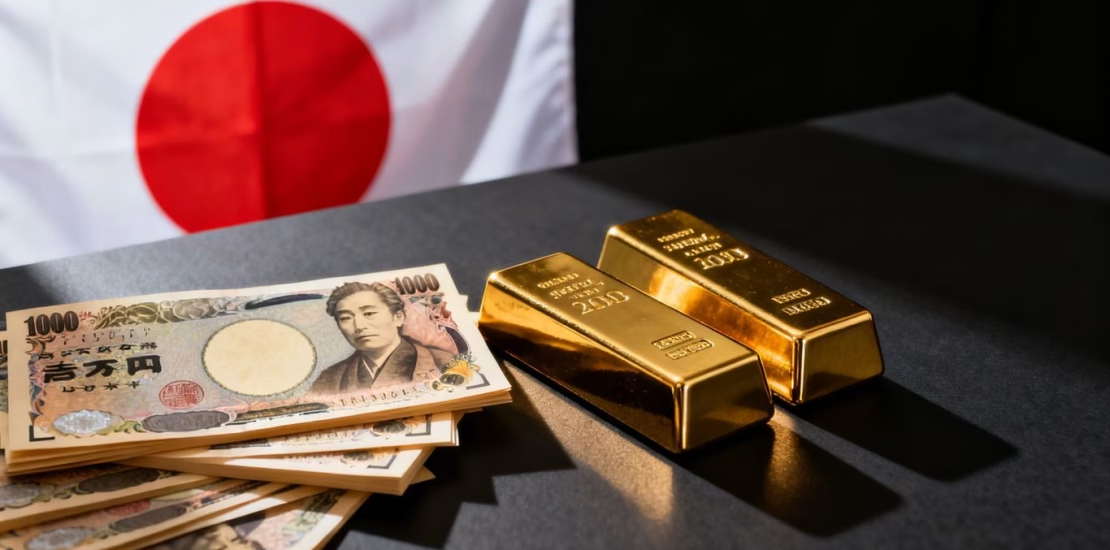
When you become interested in gold, you quickly realize it's not just about jewelry or ingots hidden in a vault. In fact, the price of gold is constantly fluctuating, influenced by many factors, and the Bank of Japan's policies play a more significant role than you might think. You might believe Japan is far away, but when the Bank of Japan changes its interest rate policy, it shakes the yen, and consequently, the gold market reacts as well.
Key points to remember
- Policy changes by the Bank of Japan, such as raising interest rates or ending negative rates, often cause the yen to fluctuate, and this is reflected in the gold price.
- When the yen strengthens, some investors prefer to hold yen rather than gold. But if confidence falls or volatility increases, gold once again becomes a safe haven.
- Bank of Japan decisions create uncertainty in the markets, and at times like these, investors tend to buy gold to protect themselves.
The evolution of the Bank of Japan's monetary policy and its impact on the yen
Wondering how the Bank of Japan's (BoJ) decisions affect the yen and, by extension, the gold market? That's an excellent question, because Japanese monetary policy has far broader repercussions than is often thought. Hang on, we're going to break it down together.
Monetary tightening and the end of negative interest rates
Just imagine: for years, Japan maintained extremely low, even negative, interest rates. The goal? To stimulate the economy, encourage spending, and combat deflation. But this policy had a major side effect: it made the yen unattractive to investors. Why hold onto a currency that yields nothing, or even costs money, when you can invest your capital elsewhere for a better return? That's when the yen began to weaken against other currencies, such as the US dollar.
But things started to change. Faced with inflation that was finally starting to show its face (even if it remained moderate), the Bank of Japan decided to change course. In March, it ended its policy of negative interest rates, a historic decision after decades of fighting deflation. Then, it took another step by raising its key interest rate to 0,25%. This may not seem like much, but symbolically, it's a complete about-turn. This rate hike, combined with a reduction in bond purchases, aims to normalize monetary policy and narrow the interest rate gap with other major central banks, such as the US Federal Reserve. This monetary tightening sends a strong signal to the markets: Japan is taking the stability of its currency seriously.
The strengthening of the yen and its consequences for investors
What does this mean for you, the investor? Well, when the Bank of Japan tightens its policy, the yen tends to strengthen. We saw it: after the decision to raise rates, the yen jumped. Why? Because higher rates make the Japanese currency more attractive. Investors who had
How the Bank of Japan's policy influences the price of gold through market volatility

The yen as an alternative or competitor to gold
You might be wondering how the yen, the Japanese currency, can influence the price of gold. Well, it's quite an interesting relationship. Historically, the yen has sometimes been seen as a kind of alternative to gold, especially when it was perceived as stable. But with recent decisions by the Bank of Japan (BoJ), we're seeing a shift. The BoJ has begun raising its interest rates, ending years of ultra-accommodative monetary policy. This new direction may make the yen more attractive to investors, positioning it as a potential competitor to gold in the quest for security.
When the yen strengthens, it can have several effects:
- Less appeal of gold: If returns on yen-denominated assets become more attractive, investors might be tempted to sell gold to buy yen. This could drive down the price of gold.
- Impact on carry trade: Carry trade strategies, which involve borrowing in a low-yielding currency (like the yen in the past) to invest in higher-yielding assets, are affected. A stronger yen can trigger massive sell-offs of these positions, creating volatility in global markets, including the gold market.
- Increased confidence: A stricter monetary policy by the BoJ may signal a healthier Japanese economy, boosting confidence in the currency and, consequently, reducing the appeal of gold as the sole safe haven.
The role of trust and international capital flows
Confidence plays a huge role in all of this. When financial markets are turbulent, whether due to decisions by a central bank like the Bank of Japan or other global events, investors seek safe havens. Gold has always been the ultimate safe haven. But the way capital flows between different currencies, including the yen, can alter this dynamic.
Imagine this: if global investors begin to doubt the stability of a major economy or its currency, they will seek to relocate their money. Sometimes, this money flows into gold. Other times, if a currency like the yen shows signs of renewed strength thanks to more orthodox monetary policies, it can also attract this capital. It's a bit of a balancing act.
- Yen volatility: Rapid fluctuations in the value of the yen, as we have seen recently, create uncertainty. This uncertainty often drives investors towards gold.
- Capital flows: The Bank of Japan's decisions can influence capital flows. If the yen strengthens, capital could shift from gold to Japanese assets.
- Risk perception: The way markets perceive overall risk influences the demand for gold. A firmer Japanese monetary policy can be seen as a sign of increased stability, which could, in some cases, reduce the demand for gold.
Ultimately, the Bank of Japan's policy, by altering the perception and value of the yen, can directly influence the demand for and price of gold. It's a complex dance between currencies and precious metals, where confidence and capital flows often dictate the pace.
Market reactions and outlook for gold following the Bank of Japan's decisions
When the Bank of Japan announces or implements changes in monetary policy, you immediately feel it in the way the markets react. Every statement about ending negative interest rates or tightening policies shifts the perception of risk.
In times of monetary uncertainty, gold quickly regains its position as the preferred asset for those seeking protection. Even if the yen strengthens temporarily, you'll notice that a large number of investors remain committed to gold. There are several reasons for this:
- The history of ultra-accommodative monetary policies in Japan reminds you that surprises are always possible.
- The volatility of the yen, especially after a long period of weakening, is leading many traders to reposition themselves in gold without hesitation.
- The international environment, with high debt and geopolitical tensions, also supports the demand for gold.
There is always a moment when you wonder if it is not better to keep part of your portfolio in gold, even if there is a rebound of the yen, because the memory of financial crises remains so strong among investors.
Investor expectations and the effects of Japanese fiscal policies
As soon as a Bank of Japan decision is announced, you quickly see flows reorganizing. Often, the reactions are based on expectations rather than facts:
- Following the announcement of a possible rate hike, the yen gains strength but gold remains attractive, as fears of renewed volatility do not disappear overnight.
- While Japanese fiscal policies appear expansionary, this weighs on the yen in the long term and continues to encourage gold purchases.
- Many investors prefer to split their investments into formats like 50g bars, making access to gold more flexible and faster if liquidity is needed, even in a changing Japanese context (accessible and flexible strategy).
Here is how positions generally evolve in response to movements in the Bank of Japan:
| BoJ Decision | Yen's reaction | Gold Reaction |
|---|---|---|
| Rate increase | + yen rise | stable/increasing |
| prolonged status quo | – yen fall | rise |
| Budgetary stimulus | – yen fall | rise |
- You notice that the more risky fiscal or monetary policy is perceived to be, the more investors secure a portion of their assets in gold.
- Side effects such as the liquidation of positions in other markets (particularly stocks on Wall Street) also have a positive impact on gold.
- Finally, even initiatives from the Fed or other major central banks play a role when their decisions are added to those of the Bank of Japan.
In summary, it's not just a yen-gold match: you have to deal with a complex environment, and gold retains that reassuring aspect that allows you to sleep better when the Bank of Japan's announcements turn unexpected.
The Bank of Japan decisions have an impact on the gold market. Understanding these reactions is essential for investors. If you would like to learn more about how these events influence the price of gold and how to profit from them, visit our website for detailed analysis and expert advice.
So, what can we learn from all this?
You see, the Bank of Japan's decisions don't just stay in economics textbooks. They have very real consequences, and not just for the Japanese. When the BoJ changes its policy, it can move the markets, including the gold market. It's a bit like throwing a pebble into water; it makes waves. So, if you follow financial news, keep an eye on what the Bank of Japan is doing. It might give you some clues about how the price of gold will move. It's really not more complicated than that.
Frequently Asked Questions
How do the Bank of Japan's decisions affect the price of gold?
When the Bank of Japan changes its monetary policy, it can affect the value of the yen. If the yen weakens, gold may become more attractive to investors seeking a safe haven. Conversely, if the yen strengthens, it may reduce the appeal of gold.
Is the yen an alternative to gold according to the Bank of Japan's policy?
Sometimes, the yen can be seen as an alternative to gold, especially if the Bank of Japan's policies make the yen more stable or attractive. However, gold is generally considered a safer haven in times of global economic uncertainty.
What are the risks to the price of gold related to the policy changes of the Bank of Japan?
Policy changes by the Bank of Japan can create volatility in financial markets. If these changes lead to increased instability or uncertainty, investors might turn more towards gold, thus driving up its price. Conversely, a stable policy could reduce this demand.
